

Wedding Gift Wishes: How to Say What You Want Without It Feeling Awkward
11 August 2026
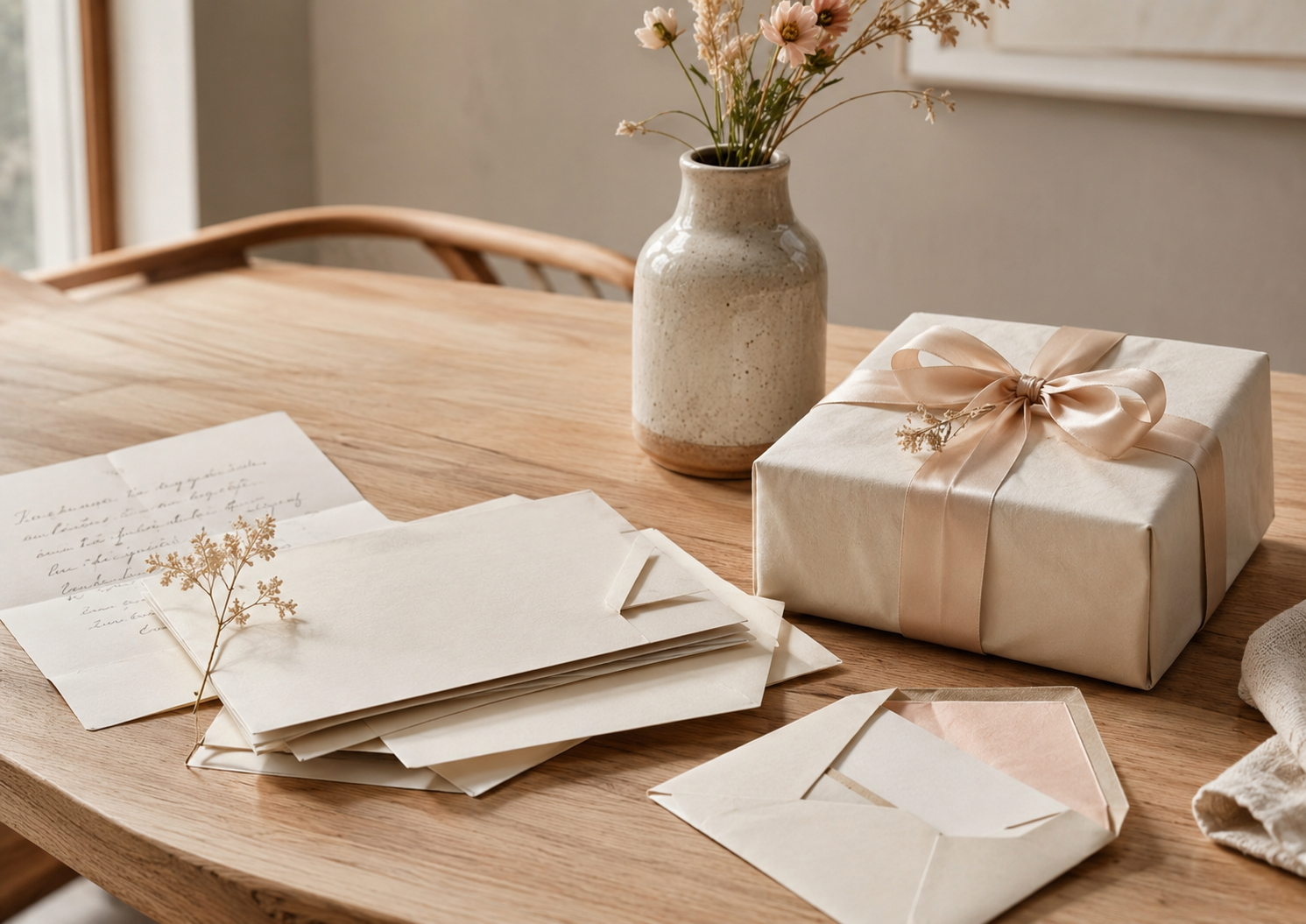
There is one topic almost every couple finds uncomfortable to bring up, and it is gifts.
Not because they are ungrateful. Quite the opposite. But because it is hard to ask for something without feeling like you are asking for something. You do not want to seem greedy, you do not want to seem unappreciative, and ideally you would rather not mention money at all.
Meanwhile, your guests have the opposite problem: they genuinely want to give you something you will actually use, and often they have no idea what that is.
So let us make this simple. Here is how to say it, what works, and answers to what everyone wonders about but few people ask.
First: It Is Completely Fine to Say What You Want
Many couples hesitate to share gift wishes because they think it looks presumptuous. But consider it from the guest's side.
A guest with no guidance has to guess. They often end up buying something they hope will suit, spending time they do not have looking for it, and sometimes giving something the couple already has two of. Nobody really enjoys that outcome.
Saying what you would like is not demanding anything. It is making things easier for people who have already decided to give you something. The vast majority of guests are actively grateful for a clear pointer.
So yes, say it. Just say it in the right place, with the right wording.
The Right Place Is Your Wedding Website, Not the Invitation
This is the most important practical piece of advice in this whole post.
Gift wishes do not belong on the invitation itself. There, they sit alongside the date and the venue, which means they read as a condition of attending. That is where it becomes awkward.
On your wedding website, it is something else entirely. There it sits with all the other practical information: parking, accommodation, dress code, the schedule. The guest seeks it out themselves, when they are ready to think about it, and then it reads as helpful rather than expectant.
Same information, entirely different effect. The placement makes all the difference.
The Wording That Actually Works
There are a few phrasings that land well because they are warm, honest, and easy to read. Here are some you can use or adapt.
If you would prefer money, perhaps towards a honeymoon or a home:
"We have everything we need in terms of things, and what matters most to us is having you there to celebrate. If you would still like to give something, we are saving towards our honeymoon, and a contribution would mean a great deal."
If you have a registry or wish list:
"If you would like to give us something, we have gathered a few things we have had our eye on for a while here." Then link.
If you genuinely do not want gifts:
"We do not want anything except your company. If you are with us that day, we have everything we need." Be prepared that some people will give something anyway, and receive it warmly.
If you would rather give it forward:
"Instead of gifts, we would love to support something that matters to us. If you would like to give, we would be grateful for a contribution to this cause."
The common thread in all of these is the same: begin with gratitude, make the wish easy to understand, and make it clear the gift is not the point of the day. Framed that way, it never reads as a demand.
Is It Acceptable to Ask for Money?
Yes. It has become completely normal, and most guests prefer it, because they know it will be useful.
Many couples live together for years before they marry and already have the things people traditionally received as wedding gifts. In that case, money towards a honeymoon, a renovation, or savings is both more useful and more meaningful than another set of glasses.
The key is giving the money a purpose. "We are saving for our honeymoon" or "we are redoing the kitchen this autumn" reads entirely differently from simply "we would like money." The purpose lets the guest feel they are contributing to something specific, and it feels better for everyone involved.
Do include a straightforward way to give, such as a payment link on your wedding website. The less practical friction, the better.
For Guests: What Do You Actually Give?
Since everyone wonders about this, here is an honest answer.
The amount varies widely, and it depends on how close you are to the couple, your own circumstances, and what is normal in your circle. Some people give a modest amount, some give considerably more, and both are perfectly fine. A common instinct is that close family give more than colleagues or acquaintances, but there is no fixed rule and nobody is checking.
The most important thing, and this is genuinely true: the couple will remember that you came. They will rarely remember how much you gave.
If the couple has shared their wishes, follow them. That is why they wrote them. And if they have not shared anything, money with a short personal note is always safe.
One small tip that matters more than the amount: write something personal in the card. That note is the part they will read again. The amount, they will forget.
Practical Things Worth Thinking Through
Who gives together? Colleagues and friendship groups often pool for a larger gift. If you have a wish list, it helps to include things at a range of price points, so both individuals and groups can find something.
What happens to the gifts on the day? With a lot of guests come a lot of envelopes and parcels. Ask one person to take responsibility for gathering them safely, and have somewhere to put them. This gets forgotten surprisingly often.
Thank you cards. Note down who gave what while you are opening, not afterwards. It is nearly impossible to reconstruct later, and the cards are far easier to write when you can mention the gift specifically.
Fjora and Your Gift Wishes
In Fjora, your gift wishes sit where they belong, on your wedding website, alongside all the other practical information your guests need. You write it in your own words, and guests find it when they go looking for it.
That keeps your invitation clean and simple, with just the date, the place, and a link to the site. No awkward placement, no explanations on paper.
And because your guest list and RSVP overview live in the same system, you have a complete record of who came when it is time to write thank you cards. Along with the memories from the day, that is the last small task of your bridal era, and it becomes considerably easier when the names are already gathered.
The One Thing Worth Remembering
It is completely fine to say what you would like. It helps your guests far more than it burdens them.
Put it on your wedding website, not in the invitation. Begin with gratitude. Give a monetary wish a purpose if that is what you would prefer. And make it clear that what matters most is that people come.
Because that part is genuinely true. In twenty years, you will remember who was there. Nobody remembers what was in the envelope.
Building your wedding website? In Fjora you gather your practical information, gift wishes, RSVPs, and guest list in one place. Get started for free.
Frequently Asked Questions
How do you word wedding gift wishes?
Begin with gratitude, make the wish easy to understand, and make clear that the gift is not the point of the day. Put it on your wedding website rather than the invitation, where it reads as helpful information rather than an expectation.
Is it acceptable to ask for money as a wedding gift?
Yes, it is entirely normal today, and many guests prefer it because they know it will be useful. Give the money a purpose, such as a honeymoon or a home project, since that feels more meaningful to guests than a general request for cash.
Where should gift wishes be shared?
On your wedding website, alongside other practical information like parking, accommodation, and dress code. On the invitation itself, it can read as a condition of attending, whereas on the website the guest seeks it out when they are ready.
How much should you give as a wedding gift?
It varies with how close you are to the couple, your own circumstances, and what is normal in your circle. Close family often give more than acquaintances, but there is no fixed norm. If the couple has shared their wishes, follow them.
What do you give if the couple has not shared any wishes?
Money with a short personal note is always a safe choice. The personal message in the card usually means more to the couple than the amount itself.
How do we keep track of who gave what?
Write it down as you open the gifts, not afterwards. It is nearly impossible to reconstruct later, and your thank you cards are much easier to write when you can mention the gift specifically.