

Wedding Planning From Start to Finish: The Complete Guide
8 October 2026
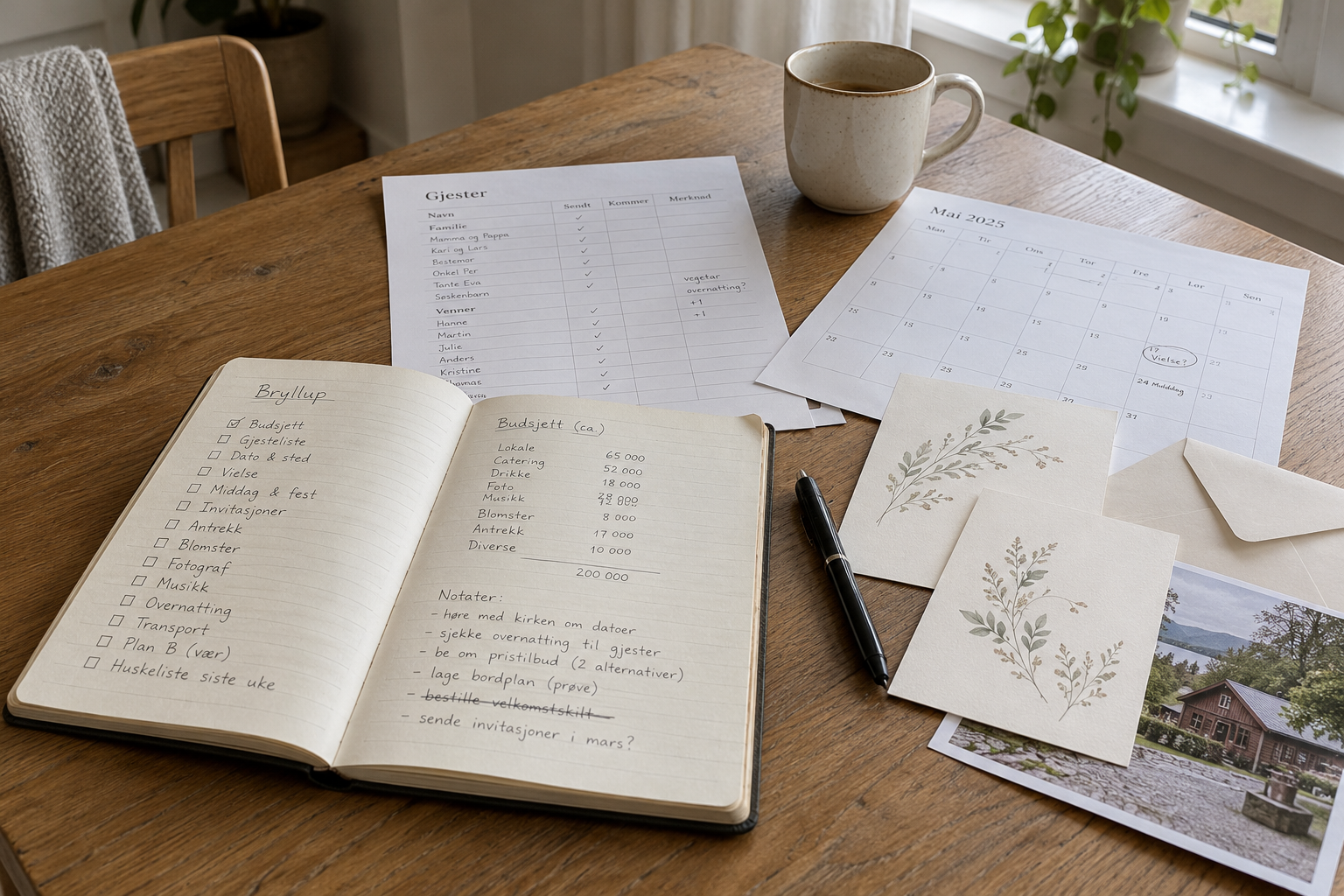
There is a reason so many newly engaged couples search for "where do I start". Wedding planning is not difficult in itself, but it is a lot of things at once, and almost nobody has done it before.
This guide walks through the whole journey from engagement to wedding day, in the order things actually need to happen. You do not need to read it all at once. Use it as a map, and skip to whatever is relevant for you now.
The Short Version: What Planning Looks Like
Most couples plan over 12 to 18 months. A common order is:
First the big frame: budget, approximate guest count, and date. Then the venue, which often determines the date. Then the suppliers that book up fastest, meaning your photographer and caterer. After that, outfits, invitations, and the legal side. And finally the details: seating chart, schedule, speeches, and the run sheet for the day.
That is broadly the whole thing. The rest of this guide goes through each step.
Step 1: Talk About What You Actually Want
Before anything is booked, have one honest conversation between just the two of you. Not about details, but about the big picture.
Do you want an intimate celebration with your closest people, or a big party with everyone you love? Close to home, or somewhere else? Relaxed and simple, or more formal?
Talk about what matters most to each of you, because it is rarely the same thing. One of you may feel strongly about the ceremony, while the other mostly wants the food to be good and everyone to have a lovely time. Both are valid answers, and they are easier to combine when said out loud early.
If you are brand new to this, we have a separate post on the first steps after getting engaged.
Step 2: Your Wedding Budget and What a Wedding Costs
The budget should come early, because it shapes almost everything else.
What does a wedding cost? It varies enormously, and the two biggest cost drivers are your guest count and your venue. They are linked, and together they set the frame for everything else.
A few things worth knowing:
Set a figure you are comfortable with, ideally slightly below your absolute maximum. Most weddings end up somewhat over the original budget, and a buffer of around ten to fifteen percent means that never becomes a problem.
Separate estimated, confirmed, and paid. These are three different numbers, and mixing them makes a real overview difficult.
Talk early about who pays for what. Most commonly the couple covers the majority themselves, often with a contribution from family who want to be part of it. We have a separate post on having that conversation well.
The costs that most often run over are flowers and decor, drinks and menu extras, and everything surrounding the outfits. Add them individually from the start.
Step 3: The Guest List
The guest list is more emotional work than logistics, and it usually takes a few rounds.
Start with an approximate number rather than names. Are you thinking thirty, eighty, or two hundred and fifty? That number determines which venues are even possible, so it needs settling before you start looking.
A few useful approaches: let venue capacity and budget be the neutral constraints you explain decisions by, decide a clear line on children and plus ones, and accept that someone will be disappointed however large or small the wedding is.
If you are planning a large wedding with more than two hundred guests, much of the logistics is different, and we have a separate guide for that.
Step 4: Date, Season, and Venue
This is where the fun starts.
Be aware that the most sought after venues are often booked 12 to 24 months ahead for Saturdays in the high season from May to September. If you are marrying in summer 2027, now is when many couples are securing their date.
Many couples find the venue first and let it determine the date, rather than the other way around. If you are flexible, you get far more options. A Friday or Sunday, or a date in May, September, or the winter months, often means better availability and more favourable pricing. Autumn weddings in particular are underrated, with softer light, ingredients in season, and guests who more often have time.
When you visit, ask the boring questions: capacity for a seated dinner versus standing, whether catering is included or can be brought in, what comes with it in terms of tables, chairs, and staff, when you can set up and must be out, noise restrictions and curfews, accessibility for guests who need it, and the wet weather plan. Always ask for a complete quote based on your actual numbers and date.
Step 5: Suppliers, and Which Ones Are Urgent
Once your date and venue are settled, the photographer and caterer are the ones that fill up fastest.
Your wedding photographer is for many couples the most important supplier decision, because the photographs are what remains. Start with the style rather than the price, ask to see a complete wedding from start to finish rather than only portfolio highlights, and check what is actually included in terms of hours, images, and delivery time. Meet them if you can, because chemistry matters when someone is close to you all day.
Catering and the menu come next. Collect allergies and dietary requirements systematically as part of your RSVP, and make sure your caterer has the full picture in good time.
After that come music, whether a DJ or a band, flowers and decor, the cake, and transport. These have longer lead times and can be handled calmly over the winter.
Step 6: The Legal Side
This is the part that is easy to postpone, and simpler than it sounds.
To marry in Norway, the Tax Administration confirms that you meet the conditions. That is done through a certificate you apply for electronically. The application consists of self declarations from both of you and declarations from your witnesses. The certificate is valid for four months, so most couples apply four to five months before the wedding.
The ceremony itself can take several forms, all of them legally equal: a civil ceremony through the municipality, a church wedding, a ceremony within another faith or belief community with marriage rights, or a humanist ceremony. Some couples combine a simple legal ceremony with a separate, freely designed one.
Remember that the ceremony must be performed by someone with legal marriage authority. A friend cannot legally marry you, but can absolutely lead a personal ceremony alongside it.
Step 7: Witnesses and Your Wedding Party
Legally you need two witnesses, one for each of you, who complete the declaration and are present at the ceremony.
Anything beyond that, meaning bridesmaids, groomsmen, or whatever you call your wedding party, is entirely optional. There are no rules about numbers, composition, or gender.
Ask in good time, ask in person if you can, and be clear about what the role involves. Someone who does not know whether a speech and a whole celebration are expected, or simply a signature and a hug, can end up unnecessarily anxious.
Step 8: Save the Dates, Invitations, and RSVPs
The timeline here is fairly settled:
Save the dates usually go out six to twelve months ahead, particularly if you are marrying in high season or many guests are travelling.
Invitations go out three to four months before, or four to six months if many guests are travelling far.
Your RSVP deadline should be six to eight weeks before the wedding, which is earlier than you strictly need it.
The invitation only needs the essentials: names, date, times, ceremony and reception locations with addresses, the RSVP deadline, dress code, and a clear indication of who is invited. Everything else belongs on your wedding website.
And the single choice that gives back most: make replying as easy as possible. One link, one form, all your questions asked at once.
Step 9: Your Wedding Website
A wedding website is not decoration, it is a time saving tool.
That is where you put the schedule for the day, addresses and maps, parking and transport, accommodation options, dress code, gift wishes, and your RSVP. Guests find everything themselves, and you are spared answering the same questions eighty times.
On gift wishes: they belong on the website, not the invitation. On an invitation they can read as a condition of attending. On the website they read as helpful information, because the guest goes looking for them.
Step 10: Outfits
The wedding dress has its own long timeline. Many bridal shops suggest ordering around eight to twelve months ahead, since a number of dresses are made to order and then need altering. This varies between shops and labels, so mention your date when you get in touch.
Set a figure that also covers alterations, shoes, undergarments, and any veil, since these usually sit on top of the dress price.
The rest of the outfits, along with rings and accessories, have shorter lead times, though rings should be ordered in good time if they are being engraved or made to order.
Step 11: The Seating Chart
Wait until you have around eighty percent of your replies before building the seating chart. Then you have a realistic number to work with.
Start with groups rather than individuals, place the difficult combinations first, give everyone at least one person they know well, and think about who enjoys being near the music and who does not.
Print place cards a few days ahead, with every name double checked and a few blanks in reserve.
Step 12: The Run Sheet, Speeches, and the Day Itself
A run sheet is the schedule for the day: who does what, when and where, from the morning preparations to the last dance. It is shared with your master of ceremonies, witnesses, photographer, and venue, and it is the reason you do not have to run the day yourselves.
Build in buffers of 15 to 30 minutes at several points. Everything takes slightly longer than planned, especially dinner with speeches.
On speeches: three to five minutes each is a good target, and it helps to ask speakers to sign up with your master of ceremonies in advance so the kitchen can plan the service around them. The best speeches tell one specific story rather than summarising an entire friendship.
And finally, the thing people forget: think about how you will get hold of the photographs your guests take. A QR code guests can scan to upload to a shared album captures all the moments your photographer could not be present for.
The Final Weeks
Three to four weeks out: confirm every supplier agreement, secure the last RSVPs, finalise the guest list and seating chart.
One to two weeks out: run sheet finished and shared, transport and accommodation confirmed, place cards and programme ready, outfits fully altered.
The final days: hand over as much as possible to others, and plan some calm into it. A well rested couple has a better day than two people who have been stressed for a fortnight.
Do You Need a Wedding Planning App?
Many couples start with spreadsheets, notes, and group chats. That works for a while, but the more guests and suppliers you have, the more time goes into moving information between places.
If you are looking at a tool, it is worth checking whether it covers guest list, RSVP, budget, checklist, seating chart, and wedding website, whether the parts connect, whether it is in a language your guests can actually use, whether you can both log in, what it costs from start to finish, and whether guests can use it without an app or account.
Where Fjora Comes In
Fjora is a Norwegian planning platform built for exactly this journey.
Guest list, RSVP, budget, checklist, seating chart, and your own wedding website all connect, so a reply to your invitation lands straight in your guest list, dietary needs follow the guest through to your catering overview, and the seating chart is built on the replies that are actually in. The checklist reminds you of deadlines along the way, including the ones most easily forgotten, like your marriage certificate application and witness declarations.
It is built in Norwegian from the ground up, with Norwegian terminology, and also works in English for guests from other countries. The directory holds more than 1,400 hand picked Norwegian suppliers, so you can find a venue, photographer, and caterer near where you are marrying. Guests respond and share photos in their browser, with no app and no account. And your wedding data is never used to train artificial intelligence.
Fjora is free for everyone who registers in 2026, and you keep your access whatever happens to pricing later.
Both of you log in and see the same thing, so neither of you has to be the one carrying the whole overview alone.
Finally
Wedding planning looks overwhelming from the outside, but it really comes down to four big decisions: how many, how much, where, and when. Everything else follows from those.
Have the conversations in the right order, secure what books up first, and let the rest come at its own pace. And remember now and then what this is actually about. You are planning a party to celebrate finding each other.
Want it all in one place? Fjora is free to get started with, and takes a few minutes to set up.
Frequently Asked Questions
How long does it take to plan a wedding?
Most couples plan over 12 to 18 months. If you want a Saturday in the high season between May and September, the venue should be secured early, ideally 12 to 24 months ahead, since the most popular places fill first.
Where do you start when planning a wedding?
Start with a conversation about the kind of wedding you want, then an approximate budget and guest count. Those three things determine almost everything else, and only after them should you choose a date and book a venue.
What should you book first?
The venue first, since it often determines the date, then the photographer and caterer if the venue does not provide catering. These fill up fastest. Flowers, music, cake, and transport have longer lead times.
How much does a wedding cost?
It varies widely, and the two biggest cost drivers are guest count and venue. Set a figure early that also includes a buffer, since most weddings end up somewhat above the original budget.
When do we need to sort the legal paperwork?
The certificate from the Tax Administration is valid for four months, so most couples apply four to five months before the wedding. The application consists of self declarations from both of you and declarations from your witnesses.
When should invitations be sent?
Send invitations three to four months ahead, or four to six months if many guests are travelling far. Save the dates usually go out six to twelve months in advance. Your RSVP deadline should be six to eight weeks before the wedding.
Is there a free wedding planner for couples in Norway?
Yes. Fjora is a Norwegian planning platform with guest list, RSVP, budget, checklist, seating chart, wedding website, and a supplier directory, and it is free for everyone who registers in 2026.