

Wedding Speeches: The Order, the Length, and How to Write One That Lands
4 August 2026
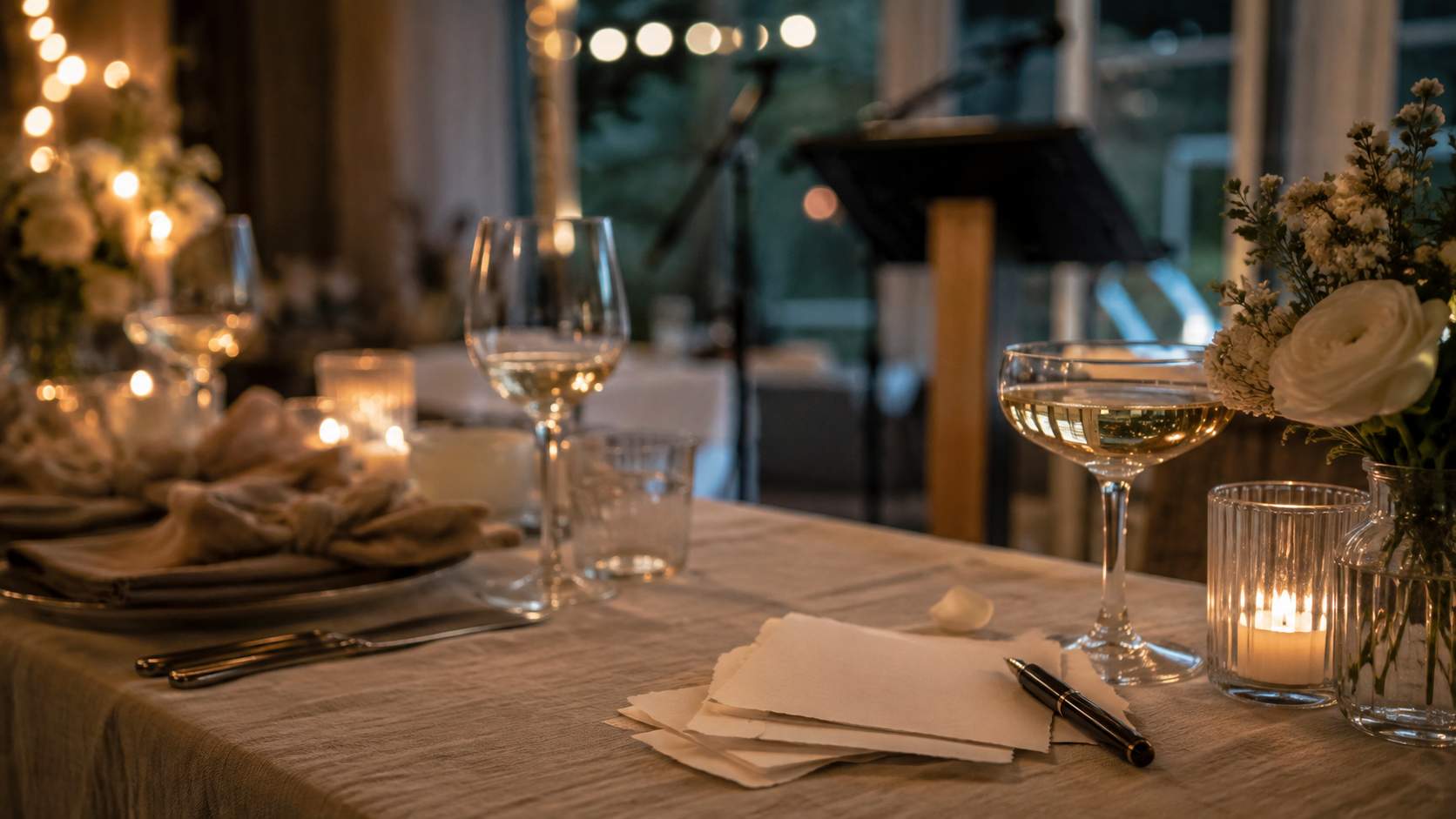
Speeches are often what guests remember most from a wedding. Not the food, not the flowers, not even the dress. The speeches.
They are also the thing most likely to break the schedule, make people nervous for weeks, and create uncertainty about who is actually meant to say something and when.
This guide is for both sides: for couples planning the speeches, and for anyone who has received the honourable and slightly terrifying news that they are giving one.
The Speech Order: Who Speaks When?
There is no rule here, but there is a traditional order that works well because it builds naturally through the evening.
A common order looks like this:
The master of ceremonies welcomes everyone and explains how the evening will run.
The hosts, meaning whoever is inviting, welcome the guests. Traditionally this has been the father of the bride, but today it is just as often both sets of parents, the couple themselves, or whoever is genuinely hosting.
A speech to the bride, traditionally given by her father or someone else close to her.
A speech to the groom, likewise.
The couple's speeches to each other. Many couples today speak together, or each in turn, whichever feels right.
The speeches from the best man, maid of honour, or equivalent, which are often the most personal and funniest moments of the night.
Open speeches from friends and family, spread out between the courses.
The couple's thank you speech towards the end, thanking guests, parents, and everyone who helped.
The point is not to follow this order rigidly. The point is that the order is decided in advance, that the master of ceremonies has the overview, and that nobody is left wondering when their moment is.
How Long Should a Wedding Speech Be?
This may be the most important section in the whole guide.
Three to five minutes is a good target for most speeches. The couple's thank you speech can be shorter still. And a speech that passes seven minutes almost always loses the room, however good it is.
Three minutes feels short when you are writing and long when you are standing there. Count on roughly 400 to 500 words for three minutes, and around 700 for five.
A practical note for the couple: multiply the number of speeches by five minutes, then add time for applause and transitions. Ten speeches quickly becomes an hour, and that hour has to be spread between courses without the food going cold or the guests going restless.
How to Write a Speech That Lands
Start with one story, not a summary.
The most common mistake is trying to cover an entire friendship or an entire childhood. It becomes a list, and lists rarely move anyone.
Choose one specific story that says something true about the person instead. A moment, a situation, a time they did something so completely them. That one story says more than ten general sentences.
Be specific rather than grand.
"She is the best friend in the world" says nothing. "She drove four hours in the middle of the night because I was struggling, and she never mentioned it afterwards" says everything.
Detail makes a speech real. Superlatives make it generic.
Speak to the person, not about them.
The strongest speeches address people directly. Say "you" instead of "she." Look at them. It changes the entire feeling in the room.
Keep the humour warm.
Humour is wonderful in a wedding speech. But it should lift the person up, not embarrass them. The simple test: would they laugh at this with their own grandmother in the room? If not, leave it out.
Avoid old relationships, embarrassing drunken episodes, and anything that requires knowing a particular friendship group. Half the room will not follow it, and the other half will wish it had not been said.
Finish with something about the future.
The loveliest speeches do not end in the past. They say something about what you hope for them going forward, or what you see when you look at them together. It gives the speech a natural landing.
And practise out loud.
Do not just read it through. Say it aloud, ideally three or four times. That is how you find which sentences do not work spoken, and how you find your own pace.
Common Mistakes, and How to Avoid Them
Too long. By far the most common. Cut a third of what you first wrote, and the speech almost always improves.
Too many inside references. Write for the whole room, not just the five people who were on that trip.
Improvising without notes. Even confident speakers are affected by nerves and atmosphere. Hold the cards, even if you barely look at them.
Drinking before speaking. One glass to settle the nerves is one thing. More than that shows from the first sentence.
No arrangement with the master of ceremonies. Spontaneous speeches between courses are lovely, but too many of them break both the schedule and the service. Sign up in advance.
For the Couple: How to Plan the Speeches
Talk to your master of ceremonies in good time about who you would like to speak, and who has offered.
Ask speakers to sign up with the MC in advance, whether through your wedding website or a simple message. Then you know how many speeches there will be, and the kitchen can plan the service around them.
Give your speakers a friendly frame. A short message saying "we are aiming for three to five minutes per speech, since several people are speaking" is not rude. It is a gift to both the speaker and the guests.
Spread the speeches through the evening between courses rather than all in a row. The room needs breathing space.
And think about who is not on the list. Have both families been included? Is anyone expecting to be asked? A little thought here saves hurt feelings later.
Fjora and the Wedding Day
Speeches are one of the easiest things to lose control of time wise, which is why they belong in the day's schedule from the start.
In Fjora, you put the schedule for the day straight onto your wedding website, so guests can see when dinner starts and how the evening is laid out. The seating chart shows where your speakers are sitting, which is more useful than it sounds when someone needs to stand up mid service. And your guest list keeps track of who has a role on the day.
Afterwards, the Memories module gathers what your guests filmed and photographed through the evening, and the speeches are often exactly what people record. Which means you get them back, including the ones you were too moved to properly remember.
The One Thing Worth Remembering
A good wedding speech is short, specific, and warm. It tells one story rather than ten, it speaks to the person rather than about them, and it laughs with them rather than at them.
And for the couple: decide the order in advance, give your speakers a frame, and let the master of ceremonies own the running of it. Then the speeches become what your guests remember, in the best way.
Planning your wedding day? In Fjora you bring the schedule, guest list, seating chart, and memories from the day into one place. Get started for free.
Frequently Asked Questions
What is the traditional wedding speech order?
A common order is: the master of ceremonies welcomes everyone, then the hosts, followed by a speech to the bride, a speech to the groom, the couple's own speeches, the best man and maid of honour speeches, and finally open speeches from friends and family. The couple's thank you speech usually comes towards the end.
How long should a wedding speech be?
Three to five minutes is a good target, which is roughly 400 to 700 words. Speeches that run past seven minutes usually lose the room's attention, however well written they are.
Who gives speeches at a wedding?
Traditionally the hosts, those closest to the couple, the best man and maid of honour, and the couple themselves. Today it is entirely open, and many couples let friends and family sign up with the master of ceremonies in advance. What matters is that the order is settled beforehand.
How do you write a wedding speech?
Start with one specific story that says something true about the person, rather than summarising an entire friendship. Be specific rather than grand, speak directly to the person, keep the humour warm and inclusive, and finish with something about the future. Practise it out loud several times.
When during dinner should speeches happen?
Spread them out between courses rather than all in a row. The welcome speech comes first, and the rest are distributed between servings. The master of ceremonies should coordinate with the kitchen so food is not sitting while someone speaks.
What should you avoid in a wedding speech?
Avoid going on too long, inside references only a few people understand, stories about past relationships, embarrassing episodes that make someone uncomfortable, and too much to drink beforehand. Write for the whole room, not just your own friendship group.