

Large Wedding with 200 to 500 Guests: Everything Nobody Prepares You For
8 June 2026
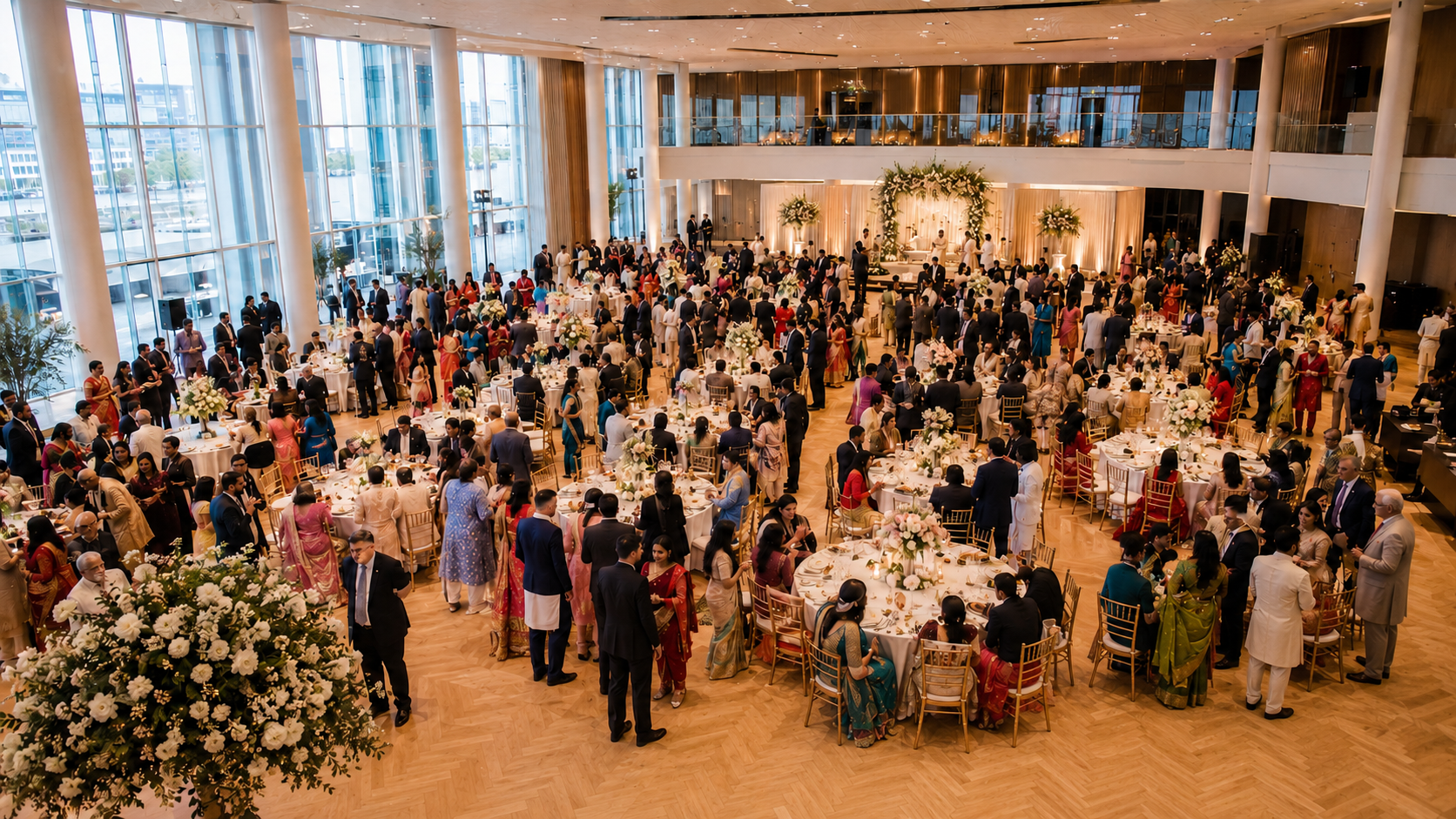
There are weddings, and then there are weddings.
A wedding with 50 close friends and family is one thing. A wedding where two families with deep roots, wide networks, and a lot of people who matter come together under one roof, that is something else entirely. Not better or worse. Just more.
More logistics. More coordination. More emotion. More of everything, really.
If you are planning a wedding with over 200 guests, maybe 300, maybe more, this guide is for you. Most wedding planning advice is written for an average wedding of 60 to 80 guests. The large wedding is a different animal, and it deserves its own honest guide.
What Is Actually Different About a Large Wedding
The obvious answer is the number of people. The less obvious answer is what that number does to every other decision you make.
The venue has to be able to hold everyone, and that limits your options dramatically. Many of the most beautiful and sought-after wedding venues have capacity for 80 to 120 guests. If you need 300, you are looking for something fundamentally different: large event halls, historic estate buildings, hotels with grand ballrooms, manor houses, cultural venues, or outdoor spaces with marquee setups and full infrastructure.
Catering does not scale in a straight line. A wedding dinner for 80 is a logistical exercise. A wedding dinner for 400 is closer to catering a mid-sized corporate event, and it requires vendors with the capacity, experience, and staffing to match.
Sound, lighting, and staging become their own budget line. What works naturally in a smaller venue requires professional rigging in a large one.
And the guest list, the seemingly simple guest list, becomes a project of its own.
A Guest List of 300 Is Not Just a Longer Version of 80
A guest list of 300 contains a human breadth that a list of 80 rarely does.
It typically includes multiple generations, from grandparents to the children of friends. It includes people who do not know each other at all and would never otherwise meet. It may include guests from different parts of the world, with different cultures, different dietary habits, and different expectations of what a wedding looks and feels like.
That is actually one of the most beautiful things about a large wedding. It is a gathering of everything that has shaped you both as people. Every person, every place, every chapter.
But it also means that guest management requires significantly more. Dietary requirements and allergies that are a simple list at a small wedding become a coordination exercise at a large one. RSVP follow-up that is manageable with 80 guests is a genuine job with 300. A seating chart that takes a few hours with 80 guests can take days with 300.
The Timeline Is Longer Than You Think
A large wedding is not planned in a year. Not if you want the best venues and vendors.
The most sought-after venues are typically booked 18 to 24 months in advance. Good catering companies with capacity for large weddings are not in unlimited supply. Photographers and videographers who are experienced with large weddings, where there is more complexity and more logistics in capturing all the important moments, are a niche within a niche.
Start early. Earlier than you think is necessary. Book the venue and catering long before you start thinking about flowers and place cards.
The Budget: What Actually Costs the Most
There are many ways to estimate the cost of a large wedding, but the most honest is per person.
A reasonable ballpark for a wedding with food, drink, and a decent venue is somewhere between 150 and 300 euros per guest, depending on your choices and location. That means a wedding with 300 guests at a mid-range level lands somewhere between 45,000 and 90,000 euros.
That is a significant amount. It is also a significant celebration.
The costs that scale disproportionately with size are venue and infrastructure, catering and staffing, sound and lighting, transport between ceremony and reception, and coordination. The costs that scale less dramatically are photography and video, music and entertainment, and the more personal details like the cake and bridal flowers.
Knowing what scales and what does not helps you prioritise where to spend and where to save.
The Seating Chart for a Large Wedding Is Its Own Project
We have written about seating before, but for a large wedding it is worth being direct: the seating chart is not something you sit down for an afternoon and finish.
With 300 guests and perhaps 35 to 40 tables, it is not just about who sits next to whom. It is about zones within the room. Who sits near the bar, who sits near the exit, who sits near the dance floor, who sits far enough from the speakers to actually hold a conversation.
It is about thinking of the room as a whole, not just as a collection of tables.
And it is about the changes. At a small wedding, one cancellation is a minor adjustment. At a large wedding, one family pulling out two weeks before can mean reorganising five tables.
Have a system. And have it from the beginning, not the week before the wedding.
Guest Communication: Underestimated and Absolutely Critical
At a wedding with 300 guests, communicating with your guests is not something you can manage manually.
A wedding website is not a nice-to-have at this scale. It is a necessity. Somewhere guests can find all the practical information they need: location, directions, parking, accommodation options, dress code, dietary alternatives, the schedule for the day. Somewhere they can RSVP without you having to manually log every response.
At a small wedding, you can answer individual questions from guests with personal messages. At a large wedding, that is not realistic in the same way. The more information you pull together in one place and make available, the fewer individual questions land in your inbox.
That saves you hours. Many hours.
Fjora and the Large Wedding
Fjora is built to handle what a large wedding actually requires: a guest list with many moving parts, RSVP management that updates in real time, dietary requirements and allergies that follow each guest through the whole system, and a seating module where you can work across many tables at once without losing the overview.
The wedding website you create in Fjora is where your guests find all the information they need and submit their RSVPs, which means everything comes in one place rather than scattered across text messages and email inboxes. Both of you have the same access and the same overview, which matters especially when the complexity is high and a lot is happening at once.
We did not build Fjora only for the small intimate wedding. We built it for the wedding as it actually exists for a lot of couples: large, full of people they love, and with more to keep track of than they imagined when they said yes.
The Best Thing About a Large Wedding
After all the practical detail, it is worth saying: a large wedding is something special.
It is not right for everyone, and it does not need to be. But for the couples where it is right, where both families are large and close and full of people who genuinely matter, where gathering everyone in one room is itself something meaningful, the large wedding is not a compromise. It is its own thing entirely.
All those people in one room. All those stories. All those relationships. It is quite something to take in, in the best possible way.
It is worth planning properly.
Planning a large wedding and need a system that can actually keep up? See what Fjora can do for guest management, seating, and your wedding website at scale.