

Most couples go over their wedding budget. Here is exactly how it happens
12 June 2026
Most couples who go over their wedding budget tell the same story afterwards.
It was not one big thing. It was that the photographer they really wanted cost more than planned, but it is only once in a lifetime. And the table decorations went a little over, but they were so beautiful. And then there was an extra course added to the menu because it was good value. And the bride's shoes. And the outdoor flowers. And the car that half the bridal party wanted.
None of those decisions are unreasonable on their own. Together, they add up to something that is.
That is how a wedding budget actually breaks. Not with a single blow, but through a series of completely reasonable choices that were never considered in relation to each other.
Why a Wedding Budget Is Harder to Stick to Than Any Other Budget
A wedding is not like buying a new sofa or planning a holiday. It carries an emotional weight that almost nothing else does.
It is the day you have always imagined. It is the people who matter most watching you. It is something that only happens once. Those feelings are entirely natural and deeply human, but they make it extraordinarily difficult to say no to upgrades, add-ons, and the slightly better version of something you had already decided on.
The wedding industry understands this very well. It is not a coincidence that there is always a more expensive option available, presented at exactly the moment when you are most emotionally invested in the decision.
That does not mean you are naive if you get swept along. It means you are human. But knowing this helps.
The Categories That Almost Always Cost More Than Expected
Some budget lines go over again and again, not because couples are unaware of them, but because they are genuinely difficult to predict precisely.
Flowers and decor. This is the category where it is easiest to fall in love with something that costs twice as much as you planned for. Flower prices vary enormously depending on season, variety, and supplier, and it is hard to estimate accurately without a real quote. Get quotes early, and have a clear sense of scale before you start looking at inspiration images.
Food and drink. The per-head cost is usually known upfront, but the additions are not always. Extra courses, wine upgrades, a cocktail hour, late night snacks, and drinks beyond the standard package are all line items that can grow quickly. Ask specifically what is included and what costs extra, and ask for a full estimate that covers everything you actually plan to have.
Outfits. The wedding dress usually has a budget, but everything around it often does not. Alterations, the veil, shoes, jewellery, a getting-ready robe for the morning of, bridesmaid dresses and their accessories. Add these individually to your budget from the start rather than treating them as one vague combined figure.
Photography and video. The photographer is usually well planned for, but an extra hour of coverage, a second shooter, drone footage, and additional video editing are all additions that tend to come up mid-process and are hard to say no to once you are already working with someone.
Transport. Particularly underestimated when there is distance between the ceremony and reception, or when guests need to be moved between locations. Coaches, cars with drivers, parking, and taxis for guests staying further away all add up faster than expected.
The Buffer: the Line Item Most Budgets Are Missing
Almost every wedding budget is missing one thing: a genuine contingency.
A contingency is not money you plan to spend. It is money you set aside for what you did not know you were going to spend. A last-minute addition from a supplier. An extra floral arrangement that turned out to be necessary. One more night at the hotel because guests stayed longer than expected.
A common rule of thumb is to set aside 10 to 15 percent of your total budget as a buffer. That sounds like a lot. But couples who do not have one spend it anyway. They just do it without having planned for it.
How to Actually Stay on Top of It as You Go
Setting up a budget is not the hard part. The hard part is keeping it updated so you always know exactly where you stand.
The most common mistakes are logging costs too late, recording estimates without updating them to actual figures, and not having both partners involved in the same shared overview. One of you can come home having committed to something that cost significantly more than planned, and the other does not know until much later.
Some practical things that help:
Log costs immediately, not at the end of the month. The longer you wait, the harder it is to remember the details, and the easier it becomes to round down on what something actually cost.
Separate confirmed, estimated, and paid. These are three different numbers and they mean three different things. You can have confirmed a cost without having paid it yet. Mixing them makes a real overview impossible.
Use a system both of you can access. A budget only works as a shared planning tool if it lives somewhere both of you actually look at. A spreadsheet only one person opens is not a shared budget.
When Something Costs More Than You Planned: What Do You Do?
It is going to happen. It happens for almost everyone.
The question is not whether you can avoid it, but whether you find out early enough to do something about it.
If the photographer ends up costing significantly more than you had in mind, there are usually places you can bring other costs down. Perhaps the florals can be simplified a little. Perhaps the late night food becomes drinks and snacks instead of a full spread. Perhaps transport can be arranged more simply than originally planned.
These are trade-offs you can make actively and calmly when you have good oversight. They become a crisis when you discover them three weeks before the wedding.
The overview gives you options. Without it, you are just hoping.
Fjora and the Budget
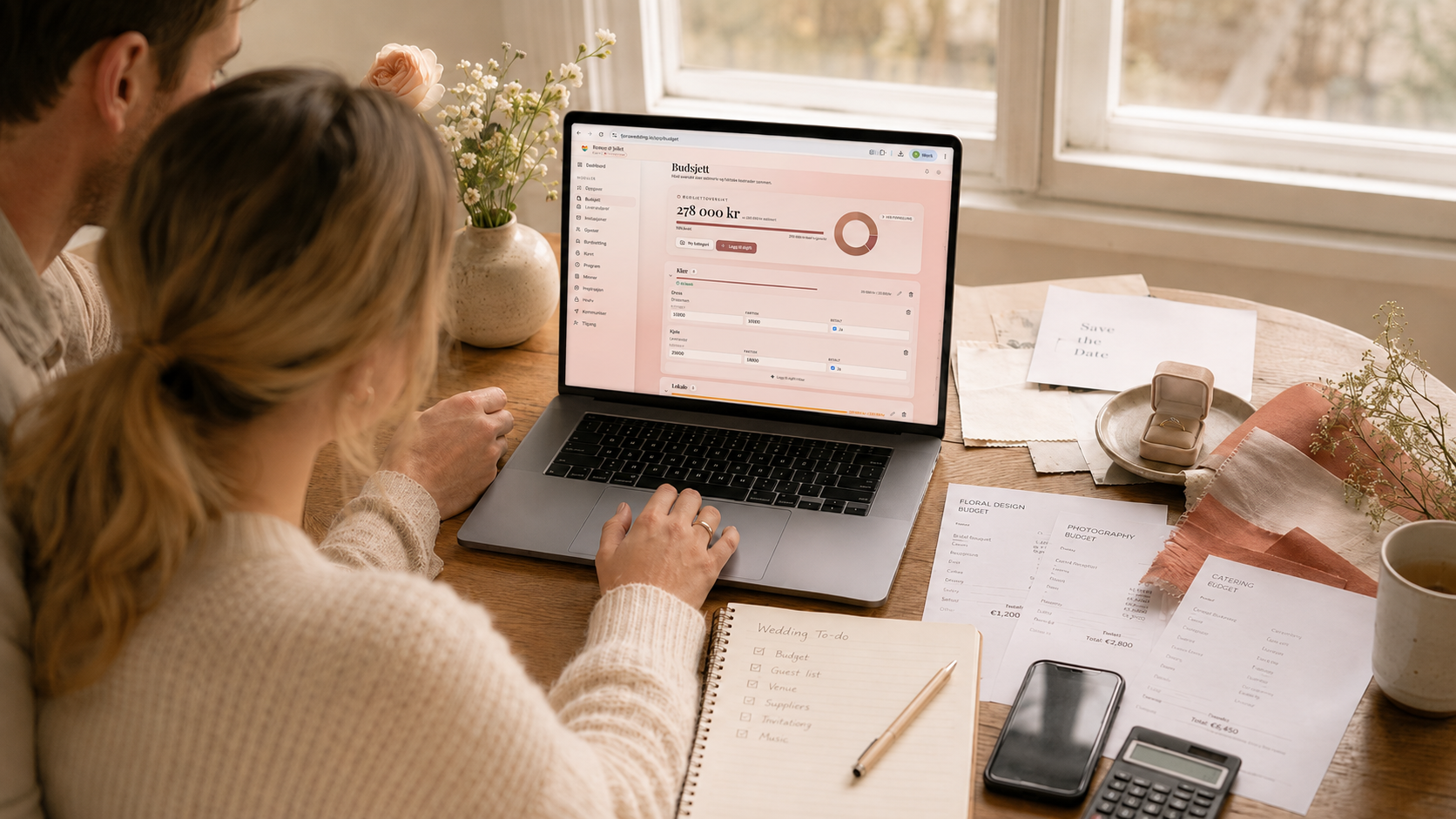
The budget module in Fjora is one of the most used features in the app, and it is free for all users.
You add line items, organise them by category, and see at any point what is estimated, confirmed, and paid. Everything is accessible to both of you at the same time, which means you both always know where things stand without anyone needing to give the other a briefing.
It does not resolve the decision between choosing the florist you really love or staying on budget. But it means you make that decision with full clarity rather than a vague sense that it will probably be fine.
That is a meaningful difference.
The One Thing Worth Remembering
Your wedding budget is not an obstacle to your vision for the day. It is the structure that lets you actually live that vision without spending the first months of your marriage working through the aftermath.
No wedding comes in perfectly on budget. There is always something that costs more than expected. But couples who keep a running overview have one significant advantage: they find out early enough to do something about it.
That is really all it takes.
Planning your wedding and want full budget visibility from day one? Fjora's budget module is free for all users and gives you both a live shared overview from the moment you start.