

Norwegian wedding trends 2026: what defines this year's weddings?
21 May 2026
Trends are interesting to read about, but they're not rules you need to follow. The most important wedding you can have is one that looks like you, not one that looks like what everyone else had that year.
That said, knowing the trends is useful. It makes you a more informed client when you're sitting across from a florist or looking at venues. It helps you understand what's available, what people are thinking about and what you might want to deliberately go against. And it makes it easier to sort out what actually suits you from what you've just seen on Instagram often enough to think it suits you.
Here's what we see defining Norwegian weddings in 2026.
Fewer guests, more presence
The strongest and most lasting trend of recent years is that Norwegian couples are choosing smaller. Not always because they can't afford large weddings, but because they genuinely want something more personal and present.
Weddings with 30 to 60 guests are no longer something people apologise for or explain. It's an active, deliberate choice. Fewer tables means more time with each individual guest, better food per person, an evening that can actually be planned down to the detail and an atmosphere where everyone knows each other.
It's closely connected to a broader shift toward the meaningful over the impressive. Many couples would rather invest in one extraordinary thing, a unique location, an exceptional dinner, a photographer they really want, than fill a large room because it's expected.
Norwegian nature as a deliberate choice
It's long been the case that foreign couples dream of Norwegian nature for their wedding. In 2026 we see more clearly than ever that Norwegian couples themselves are turning to nature, not as a backdrop, but as an active, considered choice.
The farm wedding has had a renaissance. Protected properties, old barns converted into event spaces, scenic farms with room for outdoor tents and lights: these are fully booked well in advance, and that says a lot about what Norwegian couples want.
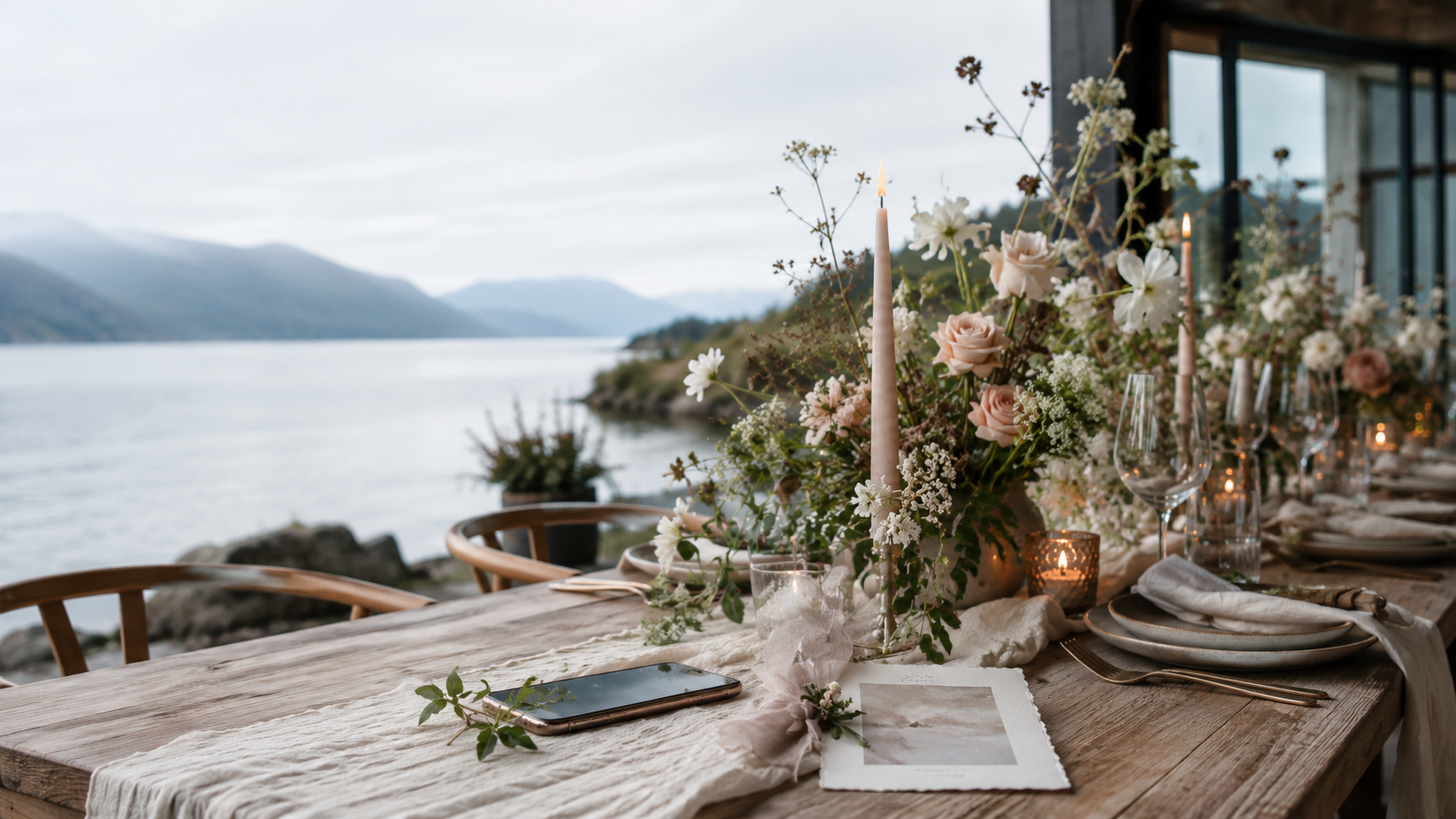
The same goes for waterside locations. Piers, boathouses, properties by the fjord and weddings where guests arrive by boat are highly sought after. Not because it's trendy, but because it's beautiful and because it gives the wedding a clear identity.
The style that comes with these choices is grounded, warm and organic. Natural materials like wood and linen. Candles. Simple flower arrangements with plenty of greenery. Nothing that competes with the surroundings.
Flowers: loose, wild and seasonal
The tight bouquet design with uniform, perfect roses is clearly on its way out. What dominates in 2026 looks like the flowers were barely gathered before being arranged: loose, asymmetric compositions with a mix of types, plenty of greenery and foliage, and a colour palette that leans toward the muted and natural.
White and cream are still the foundation, but combined with soft pink, peach and warm burgundy. For autumn weddings we see more warm red, orange and deep dark green.
What we see growing clearly is interest in seasonal, local and wild flowers. Many couples want Norwegian wildflowers instead of imported arrangement roses. It's a sustainable choice, but it's just as much an aesthetic one: Norwegian summer flowers simply look extraordinary in the settings where Norwegian weddings are typically held.
Food: ingredients and local roots
The large, formal wedding menu with five courses and a paired wine flight is on the defensive. In 2026 it's about ingredient quality and local connection, not the number of courses.
Many couples choose menus based on what's good and available where the wedding is held. Seafood from local suppliers, game from Norwegian forests, vegetables from nearby farms. Some choose more relaxed serving formats like long tables with family-style sharing or boards focused on cheese and charcuterie.
The cake follows the flowers. Simple, natural designs with berries, flowers and herbs on top. Naked cakes with visible layers that look homemade and warm. Large fondant cakes with plastic flowers are almost gone.
The ceremony: personal over standard
There's a clear movement away from ceremonies that are just a fixed template filled in with the obligatory elements. Norwegian couples are spending more time and thought on shaping the ceremony, and it shows.
Their own words. Personal vows they've written themselves. Music they actually like and that means something to them. We see it in civil ceremonies and humanist ceremonies, but also in church weddings where priests are increasingly helping couples create something personal within the liturgy.
The reason is perhaps simple: people don't want to look like everyone else. They want the wedding day to look and feel like them.
Digital and paper side by side
Paper invitations aren't gone, and probably won't disappear. But digital invitations have moved from being the budget option to being a considered choice that just as many couples make actively.
A digital invitation gives you an immediate overview of who has responded, no manual RSVP tracking, and the ability to include all the information guests need. Many couples combine the two: a simple physical save-the-date and a digital invitation with all the practical details.
What's on its way out?
Large, formal seating arrangements with strict dress codes requiring guests to wear a specific outfit and colour. Symmetrical flower arrangements with uniform roses in neat rows. Wedding parties where you can tell the couple actually wanted something else but chose the most common option because it felt safest. And weddings that look more like an inspiration mood board than something that actually resembles the two people getting married.
Trends or not: it's your wedding
We'll say it again, because it's worth saying twice: trends are useful reference points, not instructions. The best weddings we see are the ones where you recognise the couple in every single choice, regardless of what's popular right now.
Fjora's inspiration module lets you collect images, moods and ideas in shared boards. Not to copy, but to figure out what you actually want and communicate it to the suppliers you'll be working with. It's a good place to start.