

The Bridal Era Nobody Talks About: Managing Wedding Guests and RSVPs
28 May 2026
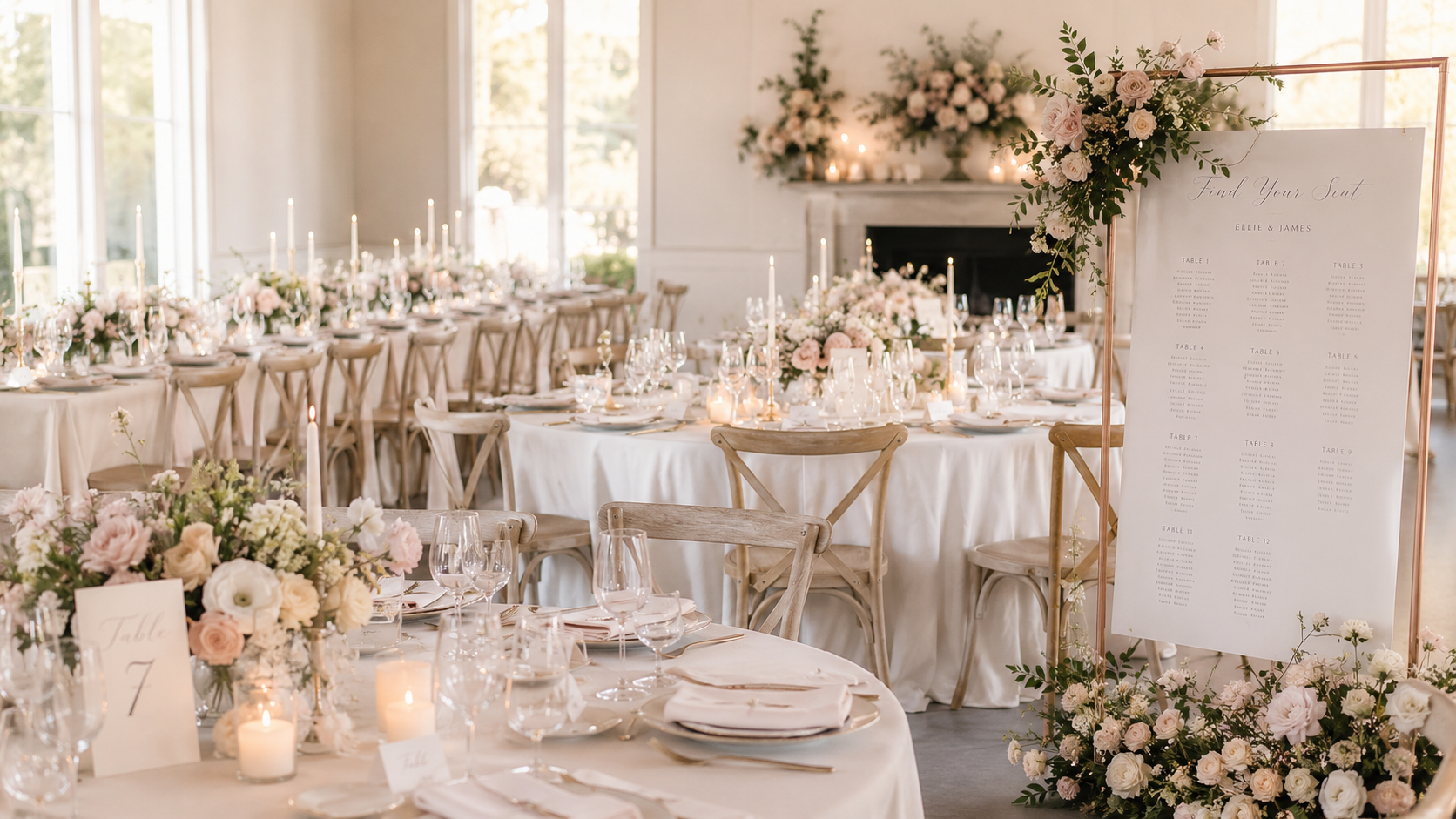
Your Guest List Is Confirmed. Now Comes the Real Work.
Everyone talks about the dress. Nobody talks about the group chat at 10pm on a Tuesday, three weeks after your RSVP deadline, when you still do not know whether your partner's colleague and their plus one are actually coming or not.
Wedding guest management is the part of your bridal era that rarely looks good on Instagram but quietly consumes a surprising amount of your time and energy. Not because it is complicated in theory. Because it involves people, and people are, as you have probably noticed, wonderfully unpredictable.
Here is what you actually need to know.
The Guest List: the Emotional Work Nobody Mentions
Long before RSVPs and place cards, there is one thing that takes more out of most couples than they expect: building the guest list in the first place.
Who is on it, and who is not. It sounds administrative. It rarely feels that way.
A guest list is, in practice, a ranking of the people in your life, and somewhere in the back of their minds, most people understand that. The decisions are never purely logistical. They are personal, sometimes political, occasionally fraught.
A few things that help:
Set your venue capacity and budget first and let those be the parameters. "We have room for 80 people" is a much easier sentence than "we decided to prioritize others." The constraint gives you something neutral to stand behind.
Agree on a children policy early and apply it consistently. A mixed approach, where some children are included and others are not, is almost always harder to explain than a clear line in either direction.
And accept, early, that someone will be disappointed. That is not a failure of planning. It is just the reality of having a finite number of chairs.
RSVPs: What Actually Happens vs. What You Expect
Here is what the RSVP process actually looks like, as opposed to how it appears in planning guides.
You send your invitations. You include a clear deadline. You wait. Some guests respond immediately and you feel briefly optimistic. Some respond a week after the deadline with no explanation. And some do not respond at all until you send a message that starts with "hey, hope you're well" and ends with a question you have already asked twice.
This is completely normal. It is not a reflection of how much people care about your wedding. It is a reflection of how people generally handle tasks that feel important but not urgent.
Some things that genuinely help:
Set your deadline two to three weeks before you actually need the information. Not one week. Not five days. Two to three weeks. You will use every one of them.
Make responding as frictionless as possible. A wedding website with a simple RSVP form, three questions, one button, done, converts significantly better than asking guests to reply by email. Email requires people to compose a response. A form requires them to click.
Ask about dietary requirements in the RSVP, not as a follow-up. It is tempting to leave it for later. Later means a second round of messages to everyone who already responded. Ask once, collect everything in one place.
Give the follow-up job to someone else. Choose one person, your partner, a bridesmaid, a parent, and ask them to own the reminder messages for guests who have not replied. It is a small thing to hand off, and it matters more than it sounds.
What Nobody Prepares You For: Changes After the Deadline
The RSVP deadline is not the end of guest management. It is closer to the halfway point.
After the deadline come the changes. Some are expected and some are not. People get sick. Work trips appear. Couples who RSVP'd as two arrive as one. A guest who confirmed six months ago double-booked themselves and is only realising it now.
Plan for this before it happens. Decide in advance what you will do when someone cancels in the final week. Will you adjust the seating? Leave the seat empty? Reach out to someone on a backup list? There is no single right answer, but having thought about it beforehand means you are not making that call in the most stressful stretch of the whole process.
And: resist the urge to reorganise everything for one change. It is almost never worth it.
Dietary Requirements: Get Ahead of This One
This is the area where it is easiest to procrastinate and hardest to recover from.
Allergies and dietary needs need to reach your caterer with enough time to actually act on them. Not three days before. Not the morning after your tasting. With enough time.
Collect this information during the RSVP process. Store it somewhere you and your caterer can both find it easily. Check it once more when you submit your final headcount to the venue.
It sounds dry. But one guest who cannot eat the meal at your wedding is a moment that stays with you, and with them.
Place Cards: The Last Step, The First Impression
Place cards are the final task in guest management and the first thing your guests encounter when they walk into your reception.
A good place card does not need to be elaborate. It needs to fit your aesthetic, be easy to read, and have every name spelled correctly.
That last point is worth more attention than it usually gets. Getting someone's name wrong on a place card is a small thing that registers, particularly for guests who are already slightly nervous about not knowing many people. Double-checking costs nothing.
Print them a few days early. Keep a handful of blanks nearby. Hand them to someone you trust to sort out any last-minute changes on the morning of the wedding, so it is not something you need to manage yourself.
Fjora and Guest Management
Guest management was one of the things we thought hardest about when building Fjora, because scattered information is where the stress lives. RSVPs in one place, dietary notes in another, a seating chart in a spreadsheet, place cards in a third program entirely.
In Fjora, all of this lives together. Guests RSVP through your wedding website, their dietary requirements travel with their guest profile automatically, and your RSVP overview and guest list sit side by side when you are working on the seating. Place cards print from there too.
Not because we think guest management should be invisible or effortless. It is real work, and it deserves to be done properly. We just do not think you should spend your bridal era copying and pasting between tabs.
The Thing Worth Remembering
Guest management is not the most romantic chapter of your bridal era. But it is one of the chapters that shapes how every single person at your wedding experiences the day.
The guests who feel looked after, who found it easy to respond, who did not worry about the food, who found their name on a card and found a seat next to someone they knew, those are the weddings people talk about.
That work starts long before the day itself.
Planning your wedding right now? See how Fjora brings your guest list, RSVPs, seating, and place cards into one place, so you can spend more of your bridal era on the parts that are actually enjoyable.